Showing posts with label Accessories. Show all posts

Thursday, December 29, 2016

 Decorators get all kinds of requests for services from furniture layout to full home designs. I like the variety of smaller jobs with  the ones that go on forever.  Two of my favourite tasks are rehanging art to best advantage and providing the last layer of accessories in a home. Sometimes I get to do both in the same house!

Over the next several posts I want to provide a glimpse into the thought processes I use when accessorizing a client’s space.   Think about it as adding the icing to an already great cake. If you do it for your own home or as a professional service, the task is really the same. You have to juggle design principles with individual taste (both decorator& clients) and existing elements in the home.

 Sometimes homeowners have  objects  to incorporate in the design and other times you may  start with a clean slate.   As a decorator, I find  a  clean slate  more difficult  because I want to choose accessories that are “sensible” for the homeowner.  By that I mean  I want to select objects that relate to  family composition, budget, existing objects  and  interests.   Here’s a little of how it goes…..

Use what is important to you
Re-use objects from other rooms
Mix shapes and scale
accessories: Making it all work

 This is a perfect example of  how existing objects  can  form the backbone of a great vignette.  The crystal vase was a wedding gift and  the lamp was in another room, but the scale was too small for that space. The homeowners had the mirror from their previous home.  When I saw the silver cut edged design in the frame that  mimicked the cuts in the crystal, I knew it would work.  I have to admit I am a firm believer in giving  new life to “previously loved” things.

There is  variety  in the  shapes in this vignette.  The major objects (table and mirror) are rectangles,  the bottle, vase and lamp are cylinders, the ceramic bowl a softened square.   Spheres are introduced in the top of the bottle and the floral shapes.  The leaves serve to soften all the shapes with their lovely droop.

 Have a mix of warm and cool tones

The homeowner wanted something to put keys in so the soft white ceramic bowl with a  coppery/bronze interior was chosen.  If everything is silver why add  warm tones ?  I like to mix metals for interest.  The jar behind  the bowl is mercury glass and it has a bronzy metal top- both work with the warm tones in the orchids.   So three cool tones and three warm tones.   I always mix warm and cool. 

Choose an accent colour from other objects or art
Move the accent colour around the vignette and the  larger space 

 Pay attention to the geometry in a space

Move  colours around the vignette.  This is a must for success.  When you have a mirror and a small space you can depend on what is on the opposite wall to add to your vignette.   You can see glimpses of  the opposite side of the porch  in the mirror. 

Choosing an accent colour
All the walls on the main floor are a cool blue gray.  You already know I like to mix warms and cools in any scheme, so I wanted a warm colour to offset the cools.   The first thing I chose for this room was the art. The pillow was second. The art was chosen based on what I observed hung in the home on my first visit. Two of the pieces had orange as a primary colour and both had elements of  landscape in them.  This is a more interpretative landscape which is also usually  a safe purchase.  The lines of design in the painting  bring the viewer in an up thus adding depth and height to this small space. it works well with the scale of the bench and the the nine foot ceiling.

I couldn’t pass up the repetition of the back shape of the bench in the pillow.  It serves to break up the dark in this small space and moves your eye around.  I also love how the diamonds duplicate the linear quality of the trees but in a more complicated way.

 Choose items that can work in several formations


 If you choose your objects wisely you can move them around and add seasonal items to the decor when needed. And most importantly of all do not get over stressed when things mysteriously get bumped or shoved off centre as the table in the above shot!  People live there.   


And that is why homeowners call a decorator!

The post Accessories: Making it all work appeared first on Decor Pur.

Part 2 of 5

Accessorizing a client’s home

I’m often asked what is the most difficult job I do as a decorator.  Truthfully it is to accessorize a home.  Not because I can’t create beautiful vignettes or select interesting objects, it’s because I have a belief in individual expression in a home, and it is so difficult to feel this, and then try to create a look for someone else. The one thing I have as a decorator is an unbiased eye for someone else’s space. That is helpful, and I often see new life in their discarded items.

How I do it 

With clients I spend a lot of time chatting and gathering information.  I ask them to pull out all kinds of objects they already have, even ones they think they don’t want anymore, and look for things to integrate with newly purchased objects.  Check out this post to see one client’s vignette.  I find out about their interests, travels, background etc.  I consider if they have children and what their interests are.  It is also worthwhile to look at children’s art work for inspiration.  Another telling activity is to look at what is currently in a home and ask questions about its origins, etc.  When I ask how they want people to  feel/think when they come into their home, I usually get guidance for the overall look clients are going for.   Then I  put all the information together to come up with meaningful accessories that work for a particular  family.

inspiration board, organic, geometric, spring green
Client inspiration board – organic references 


This inspiration board was created for clients who were interested in finishing their space with additional accessories to add to objects they purchased during their travels.  When I looked at what they already had, I could see strong contrasts,  elongated textural sculptures, and several vibrant colours.  I chose an earthy green, nature references and rounder shapes to work with the more elongated ones they already had.  I wanted to warm up the predominant ” blackness” of their space and play into their obvious interest in geometric motifs and texture.  With the inspiration board in hand the clients chose to shop themselves over time to complete their space.  The flowers of course never happened!  Twigs were more their style.

A long term activity

Adding the final touches to your home can take a long time.  You many have certain things in mind and can’t find them; you many have budget restraints after purchasing big ticket items; you may be just plain exhausted doing everything else, and have no energy left to deal with little things. Or you can be bored with what you have and want to start over.   No matter where you are on the accessorizing continuum, you need to have a plan in place to create an interesting, personal space.

Two ways to do it

Of course the easiest way is to hire a decorator!  An inspiration board like the one above is a very affordable solution, and you can purchase all the objects referenced online, or you can use it to shop your area.  When people want to purchase locally, the inspiration board would contain objects/furniture available in the city.  Most decorators also have rates for personal shopping for clients.

If you want to do it all yourself, I suggest the following:

  • Look online (Pinterest, Houzz) and collect inspiration images looking for patterns,  objects, colours, textures that  resonate with you; look at how they are displayed/arranged;

I keep way too many files on Houzz and Pinterest to use as inspiration and reference when talking to clients about concepts. 
  • Make a list of possible items for accessorizing from your inspiration images; have headings (e.g. art, table top vignette, pillow arrangements and styles etc. )
  • Remove all the accessories in the space you are working on and put them in another room; 
  • Check your storage areas  and other rooms to see  if you have things that might have a new life in a different space;
  • Look at your collection and choose anything  that you love and think could work in the space;
  • Bring them to the room you want to accessorize and place any that work; 

I went to my own storage area to see what extras I didn’t have in use. Then I integrated some of them with arrangements I already had in my dining room to show you how many things can work and be changed around.  Obviously I care about these objects or they would have made their way to charity. 
dining room vignette, Boblen vase, accessories,

 These two items on the right get used for all sorts of things.  The top is image shows a Boblen  vase that I wrote about here, and the plate is part of a set of 8 that I use for entertaining.  It also works as a candle holder or propped up on a small plate holder it becomes a graphic piece of art.

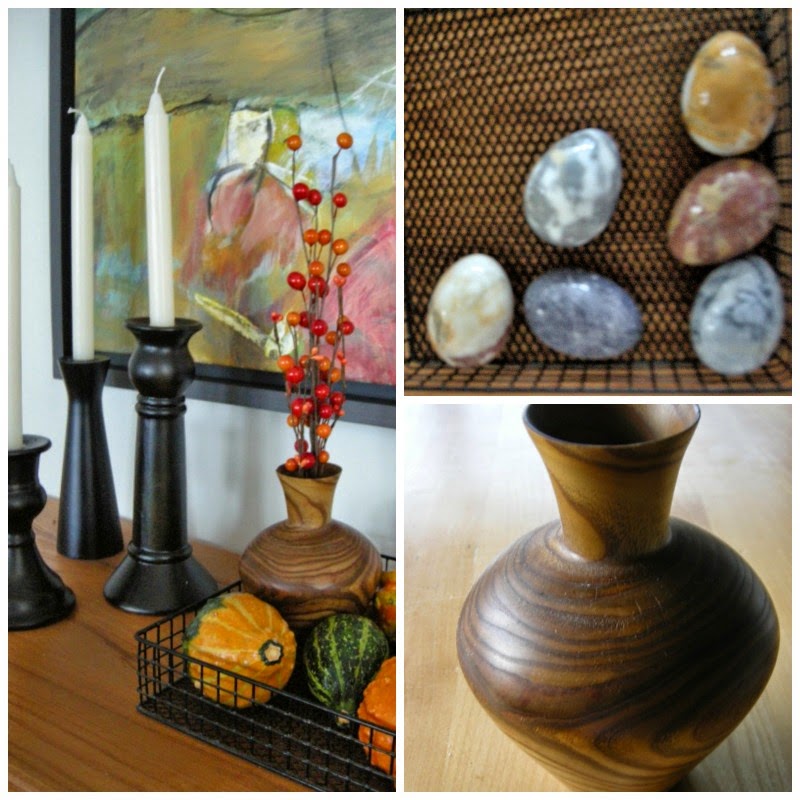
wooden vase, black candle holders, fall decorating

 The black mesh square tray was the base for a gift  I received last Christmas.  Black and square are two of my loves, when you add texture how could I let it go?  Anything hand made is alway a keeper especially when it has the beautiful form this vase does.  A few colourful berry branches the colour of the season can change the look completely.  Use your imagination about what additional seasonal objects you place in the basket/tray.

stone eggs, accessories, black candle holders, vignette
And on to the stone eggs my sister gave me years ago.  This hand crafted white  bowl has a beautiful irregular form and can be filled with all sorts of goodies. 
You get the idea.  Once you’ve found homes for the objects you love,  you can…
  • Make a list of what else you will need;
  • Record needs and the size/height/colour of objects; 
  • Take pictures of the areas you want to accessorize;
  • Go shopping (with your phone)! Don’t forget to look in second hand stores, antique stores, dollar stores, craft studios, and on line second hand sales sites.  

Oh yes, trade with your friends and/or siblings!

Check back for Part 3 of my accessories posts where I visit a local home to explore how the owners went about adding the final touches to their new home.

The post Accessories: A decorator’s perspective appeared first on Decor Pur.