Showing posts with label Dining. Show all posts

Wednesday, December 28, 2016

Large can have a lot of meanings, but in Newfoundland large often  mean great or good or the best as in ” it’s a large day”.   Given that understanding here’s  a “large” dining room and a closer look at why it merits that rating.
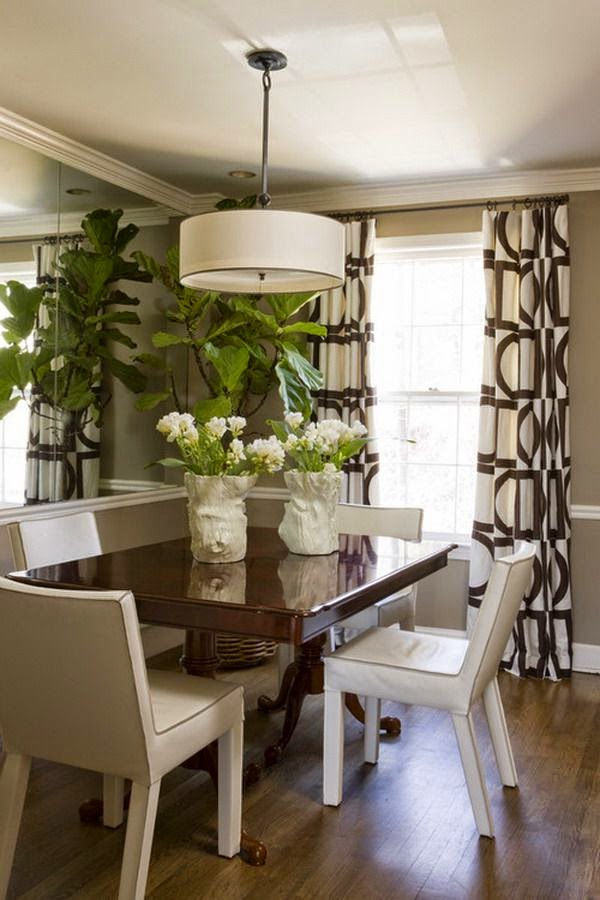
small dining room, design lesson, tips
Liz Levin Interiors 

This room has a lot packed into a very small space.    Just imagine this space with a matched dining set.  It would blend into the floor and be totally blah.  How did the designer achieve this look? Perhaps there’s something in her kit of tricks that you could use.


Upholstered chairs

  If you have a dining table you love, and hate the chairs, consider changing them  to coloured leather or fully upholstered ones.  It helps break up all the wood that you tend to get in dining rooms.  This approach usually means you can get away without the area rug that many people have to resort to so their set doesn’t disappear into a similar wood floor.

Mixing styles

I know this isn’t for everyone, but if you like a more curated rather than matched look, it’s the way to go.  The days of sets are long gone.

Contrast

Nothing attracts the eye better than contrast.  It is a design fact.  If you want a more neutral space without it being boring use contrast widely.   The dark table, cream chairs, and white and brown draperies work so well together.  Reusing the cream in the centrepiece adds another contrast point.

Pattern

I’m a big believer in using pattern to add interest to a space.  The geometric pattern in these drapes
 mimics other shapes in the room, both circles and rectangles. The colour scheme is replicated in the drapes. The drapes also provide  what I like to think about as destination viewing- a spot for your eye to seek in a room and rest before moving on.  Pattern is often the bow that ties up a space.

Mirrors

A mirror goes a long way to enlarge and add interest to small places. Personally, I like a framed mirror where this one appears to be  adhered to the wall.  Don’t be afraid to go large when you hang a mirror in  a dining space.  A word of caution.  Check what is reflected in it.  Perhaps it might be something you would rather not draw attention to.

 Living things

And most importantly this space has living things in it.  There is nothing like plants and flowers to add a dynamic touch to any space.

Texture

While this is a small space it is packed with subtle textures and sheens: wood, glass, pottery, weave in drapes, and plants.  Texture is the most overlooked design element in many spaces.   If your own space looks blah maybe adding some texture will help.


Fine craft


 I like the form and texture of the vases on the table.  While I don’t know for sure they look like fine craft. Nothing is more boring than a room full of “accessories”  from big box stores.  There’s so many unique, hand built objects in every city and town.  I contend it is more interesting to have one or two interesting objects than a house full of mass produced stuff.  You may disagree.

All of these elements work equally well  in a small space or a large space.

And here’s a space to check out to see if any of the points I mentioned above are present.  It’s isn’t a small space, but you will see a lot of the same elements and principles applied.

Blackband Design 

Lots of points to consider and possible some you might like to play around with.  What are your strategies to create a “large” room?

The post Design lesson: Giving a large look to a small dining space appeared first on Decor Pur.

Thursday, December 22, 2016

In January during a blackout our pipes broke resulting in water damage to a number of rooms in our home. What was a bit of a disaster turned into a positive for me because it finally got me moving to do something about  one of my biggest decorating problems.  That would be my dining room…. See my complaints in this  post .  It’s quite a list. 


Too much of a good thing

This is how it all looked  in early 2000 …..

problems furniture arrangement dining room
Wood, wood and more wood


Problem lines  

Wood everywhere isn’t the only problem.  Note the all the horizontal lines from the buffets to the railing,  a light hung too high and a window that has a view of the window next door.   Below is my first attempt to solve some of the highlighted problems.

arranging dining room furniture
 A different orientation solves some problems

Rearrange and add


I liked the changes and that satisfied me for a short time.  The new light was a good height and the roundness worked well against all the rectangles.  I also added longer (very temporary and too short) drapes to break some of the horizontal lines.    I moved the art work from  the living room to dining room,  and created some height and brightness on the dining table.  Still seriously problematic in my book because I did nothing to alleviate the wood issue, but it was improved but sorely lacking  pizazz.

Enter 2014… 

The power of paint and fabric

One of the cheapest updates you can make to any space is to paint something.  I don’t care if it is furniture, accessories or walls, it works every time. Since we had to repaint all the walls (BM Glacier white) I continued on to paint quite a few things which I will reveal over the next several posts.  


painting upholstery dining chairs gray circles
 Bringing  it into 2014


To break up the wood and the set,  I was determined to sell all the dining chairs and buy new ones. I still don’t know how I got hubby to agree to selling 8 hand made solid ash chairs because they were too matched. He was probably fed up listening to complaints!

After an extensive search,  I realized the chairs that looked best with the table  were the ones my husband made for it. I don’t like sets, but in this case I had to concede.  So … after much discussion with sister and daughter and varying opinions, I found a fabric I loved and then choose spray paint to work with it. 

I would like to say that cleaning and spray painting 8 chairs was exciting.  Not so…. But I got to use my favourite motif (circles) and my favourite colour gray. What could be better!   Part 2 coming soon… new problems and solutions. Hint:  Look at the vignettes on the buffet and table.

What do you think?  


The post Dining room solutions appeared first on Decor Pur.

Saturday, December 17, 2016

When someone says dining room, what picture appears in your mind?  Try  it.  List the elements.

For many of us these words conjure up a dining room set with everything matching, a chandelier and some sort of hutch or maybe buffet.  Probably a picture of some sort will be included.  I bet matching is the most obvious characteristic.

It doesn’t have to be that way unless that’s what you like.

 Here are 5 ways you can  make your dining space stand out a little.

Mix and match your chairs and table

dining table, upholstered chairs,

The days of dining sets have moved behind us.  In many magazines you will see all sorts of mixing of styles, materials and colours. I love the look of upholstered chairs with a wood table. They soften the hard edges and provide some relief in the “wood” department. Some adventurous types will go for two different styles of chairs.

mixing modern table and traditional chairs
 Adore magazine

 Another option if you aren’t too adventurous is to upholster each of your wooden chairs with a different, but co-ordinated fabric.  Note how this room sports more traditional chairs with a very simple table.

mid century modern dining chairs, charcoal dining chairs, buffets

In the case of my own dining space, I painted my matching chairs charcoal  and upholstered them with a much lighter fabric to make them the centre of interest in  my sea of golden tones. I am trying to get up enough nerve to paint the solid ash buffets the same colour.   I’m not there yet.  It’s difficult when your furniture is all hand made with love.

Look for a harmonious  buffet 

Forget about having a matching buffet (I wish I could!).  Look for one with the same undertone as your table  or chairs and similar lines if you like, or go for something painted or a different style entirely.  Some element of it should relate it to the room as a whole: wood tone, style, or colour of other objects in room.

Here are two I would choose for my space to work with my chairs.

They certainly harmonize with the darkness of the chairs, the style is mid centuryish like the table and I like the fact they are both raised off the floor.  This openness will give the illusion of space, always an added plus in a small room. 

Have at least one hand made/original item

 We live in a mass produced economy where the answer  to everything is in a big box store.  Not so.  Save your pennies, visit an antique shop, a fine craft store or gallery.  Look for something you love, made by the hand of an artist, and place it with pride knowing it’s unique.  It doesn’t have to be large.

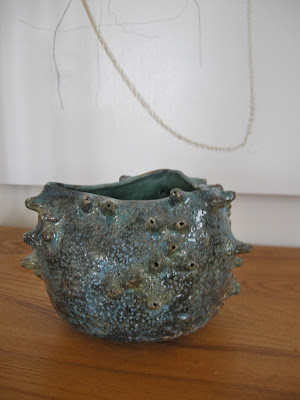
ceramic pot, Anita Singh, barnacle
This month I have a lovely pot on my buffet created by an artist friend, Anita Singh.  I love her work 

because it always relates to the natural world.  Barnacle is always a conversation piece.  It is also the perfect example of my next point.

Use a variety of textures

white textured vase, silver candlesticks, mother of pearl
Textures make the most interesting addition to spaces, and it is the element that I see under-utilized  in homes. In my space I have silk drapes, lots of wood grain, a highly textured plant container made from ceramic, a white wavy vase, metal candlesticks with mother of pearl, and two plants.  I love texture!

Choose one unexpected element

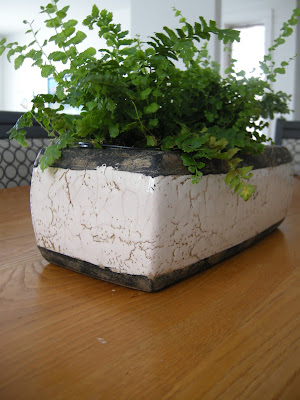
Right now the pot my ferns are in is my an unexpected item.  It is so rough and worn looking and I have it paired with silk drapes. Other options could be your light fixture, a painting, something on your tabletop or a small piece of furniture in a corner.  Some would say it should have bling, but I’ll leave that up to you.

textured trough, boston ferns

What’s your “interesting ” score?

 This is a very arbitrary checklist, based on what is “current”  in my  decor reading and viewing.   Hardly scientific!

No my dining room isn’t perfect but hopefully it is interesting.
Just because I write about design doesn’t mean my space is perfect (whatever that means) or that it even lives up to what I know about the elements and principles of design.  There’s the small matter of competing priorities including: budget, interest and energy, connections to objects and furniture, beliefs about your role consuming and junking, and the desire for good old predictability in your environment etc.

The post 5 Ways to add interest to a dining room appeared first on Decor Pur.
Sunday, December 11, 2016

The right lighting can make a room sing, but often our rooms are  off key. When you have a house of a certain age (30 years for me) there comes a time when you know you have  to update your look. When I started to change the lighting in my home, I began with the two over my tables because they would have the most impact.

dining table, lighting, drum pendant, contemporary,Designing Home, Margaret Ryall
Kitchen table 


When you’re buying lighting to hang over a table you should consider these  factors:

 Height of ceiling


A taller ceiling  often requires  larger fixtures; many new home builds in my area now have 9 foot ceilings.


Size and shape of table


Your fixture should complement not overpower your table.  You can also have lighting fixtures that are too small for a table.  I am particular about  what shape fixture I mount over a round table; I like to repeat the shape with a circular format, but that’s just me.


Height of homeowners


It is a fact that tall homeowners have a greater chance of continually bumping into lights hung too low over a table when they are setting or removing dishes.  Some people are so tall your would never mount pendants high enough!


Height above table


The specifics of how high to hang your fixture can be confusing because you will find a range of suggestions depending on which sites you consult.  Don’t let that deter you.  My adage is “Common sense prevails”.

 I tend to think in terms of a range while taking other factors into account including: personal preference, the height of the homeowners, fixture size, style of fixture, ceiling height, task to be illuminated etc.  Read on for examples.

    graphic lighting your dining table
    Light Planning and Styling Guide 

    The general recommendations for  hanging a fixture over a table is 28 – 32 inches above the table if you have an eight foot ceiling.  This graphic from wegotlites recommends 30 inches from the table for an 8 foot ceiling.   I placed my kitchen table pendant  at 32 inches from the table top so I wouldn’t continually bump it when working. It works most times, but when I reach in too far I still bump it.

    dining room pendant, hanging height,
    Art by Mike Gough 

    My dining room pendant is 34 inches from the table.   Being able to view my art collection to best advantage in very important to me, so  I moved the  dining room pendant up an additional two inches from the hanging height in the kitchen  so visitors can  view the art over the buffet without disruption while sitting in the living room.  You may not find this consideration in any lighting guide!

    Another set of guidelines recommend measuring  from the floor  to the bottom of the shade and suggest 60 – 66 inches as reasonable.  Most tables are 30 inches high.  That would put the height from the floor  to my kitchen  shade at 62 inches, and my dining shade at 64 inches, both are within this guideline.

    If you have ceilings higher than eight feet, go up 3 inches for each additional foot above eight feet.

     Size of fixture

     For most applications the diameter of your light fixture should be at least 1/2 the width of your table or even up to 2/3 the width of your table.   My kitchen fixture is exactly one half the width of the table at 18 inches in diameter.  That’s the proportion I like.  I could have gone with a diameter of up to 24 in. without it looking too large.  My dining fixture is only 16 inches  in diameter, but looks larger.

    Sizing based on room dimensions

    graphic lighting your dining table, Designing Home, Margaret Ryall
    Light Planning and Styling Guide 

    There is another guideline for determining the size of your fixture. Add the length and width of your room together ( eg., 11 feet +14 feet ) and convert the sum to inches (25in.) and that should be the diameter of your  fixture.

     Of course that is not a hard and fast rule, but it will provide a light fixture that is a focal point for the room.  This formula works better for a statement fixture  in an entrance or stairway.  You can see how it could get out of control in a dining room.  Eg. 15 feet + 20 feet would give a fixture diameter  of 35 in.  That’s the width of most dining tables. 

    Function of fixtures

    The illumination given off by drum shades  is soft and calming,  but  bright enough to provide lighting for an entire room.  When a large drum pendant is hung over a table it not only anchors the vignette, but if placed on a dimmer the fixture can provide brighter light for any tasks done at the table and softer light while dining. While I don’t have anything against chandeliers, I don’t have any in my own home.I’m definitely into clean lines and a very sparse contemporary feel.

    I am planning another post about lighting selection for various rooms as I get ready to replace the fixtures in my summer house.   Stay tuned.  

    What variables do you consider when hanging a light over a dining table?

    The post Lighting your dining table appeared first on Decor Pur.